Stop AI sales drafts from quoting old pricing
Why AI sales proposals pick up old prices, and how to fix it: one dated price book, number-free templates and a quick pre-send check on every figure.
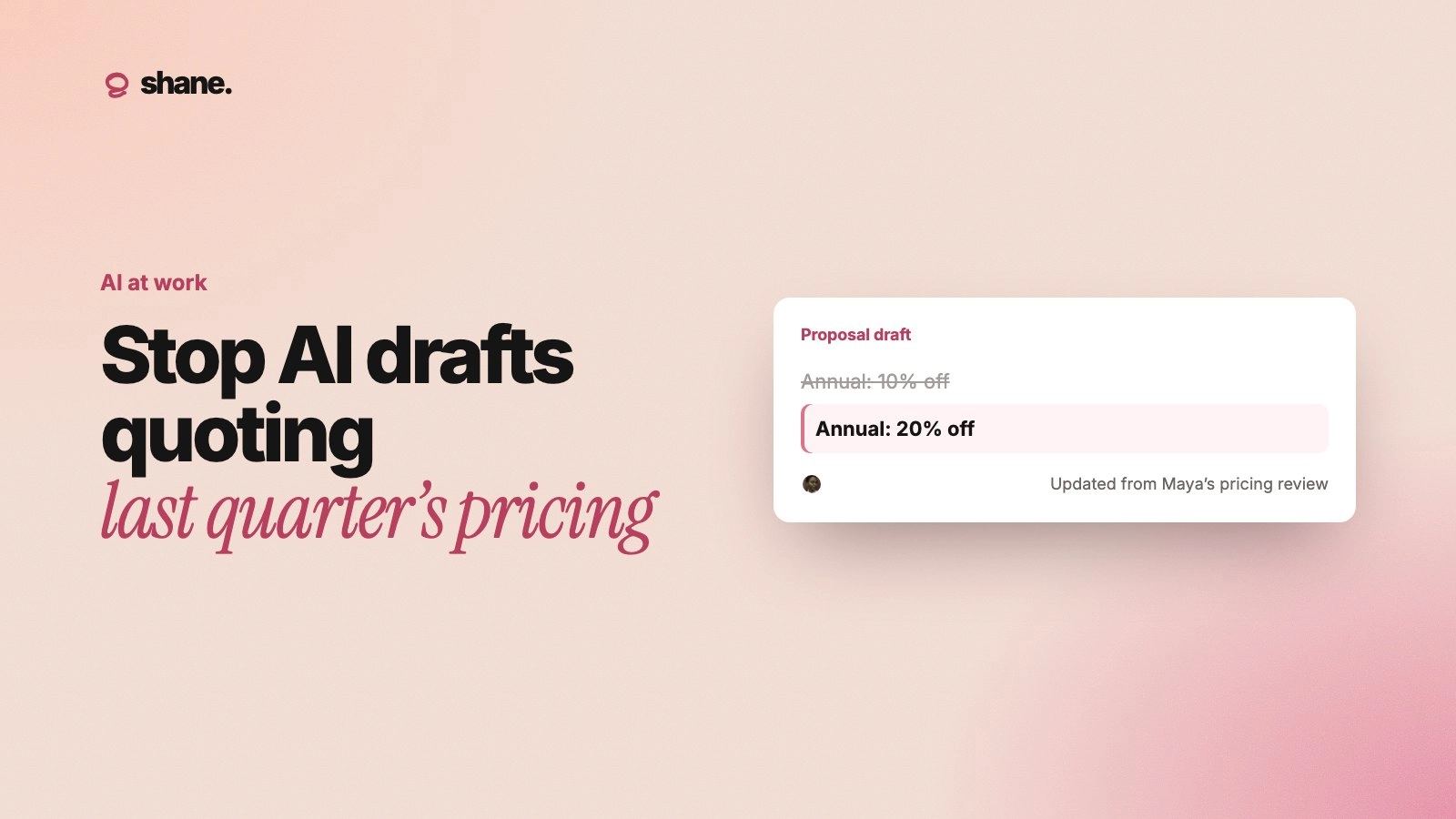
AI sales drafts quote old pricing because they copy from old proposals, old decks and pasted price sheets, not from your current price book. To stop it, keep one dated price book that every AI tool reads, stop using past proposals as templates for numbers, and check every figure in a draft against the price book before it goes out.
A proposal with last quarter's price is worse than a slow proposal. You either honor a number you didn't mean to offer or you walk it back in front of the buyer. Here's how to keep AI-assisted sales drafts on current pricing.
Why AI drafts pick up old prices
The model doesn't know your pricing. It knows whatever text it was given in that chat. In most sales teams, that text comes from a few places:
The last proposal that worked. A rep pastes a won deal from March into ChatGPT and asks for "the same, for this customer." The March prices come with it.
Decks and one-pagers. PDFs get downloaded, attached to emails and uploaded into AI projects. Nobody recalls them when prices change.
Personal AI chats. A rep set up a "proposal helper" chat six months ago with the price sheet pasted in. Gartner found that 88% of employees with access to enterprise AI also use personal AI tools for work (reported here). Those chats sit outside any update process.
CRM notes and email threads. "Offered 25% off to close by end of quarter" is true for one deal. An AI reading the CRM can treat it as the rule.
The model's guess. Ask for a proposal without any pricing input and some tools will fill in a plausible number. Plausible is not correct.
Each copy was right on the day it was made. The problem is that nothing tells the AI which one is current.
Build a price book the AI can read
The fix starts with one document that is the only place pricing is defined. Call it the price book. It should be short, dated and written so both a new rep and a model can apply it without asking anyone.
What goes in it
Section | What it covers | Example |
|---|---|---|
Header | Owner, effective date, status | Owner: Head of Revenue. Effective October 1, 2026. Current. |
List prices | Every plan and add-on, with billing period and currency | Team plan: $40 per seat per month, billed annually |
Discount rules | What a rep can give alone and what needs approval | Up to 10% for annual prepay. 11% to 20% needs sales lead approval. Over 20% needs the CEO. |
Grandfathered terms | Who keeps old prices and until when | Customers who signed before October 1 keep $35 per seat until their next renewal |
Things never to offer | Hard limits | No free months. No price locks longer than 24 months. |
Change history | Short list of past versions, each marked replaced | July 2026 price book: replaced October 1 |
The numbers above are made up. Your price book will be different, but the shape is what matters: the AI can see the current rule, the old rule, and when one replaced the other.
Write rules, not just numbers
A table of prices isn't enough. Reps and AI tools need to know how to apply them. Write the logic in plain sentences: "For deals over 50 seats, offer the volume tier. Never stack the volume discount with the annual discount." Add two or three worked examples. When something isn't covered, the rule should be: "Leave the price blank and flag it for the deal desk."
That last rule matters most. An AI that leaves a gap is safe. An AI that fills the gap with a guess is not.
Change how reps use AI for proposals
The price book only helps if AI tools actually read it. A few habits make that happen.
Separate the words from the numbers
Let AI write the parts it's good at: the summary of the customer's problem, the scope, the timeline, the case for your product. Pull every number from the price book or your quoting tool, not from the draft. Some teams use a placeholder like [PRICE: Team plan, 120 seats, annual] in the AI draft and fill it from the price book in a second step.
Stop using old proposals as pricing templates
Old proposals are useful for structure and tone. They're dangerous for numbers. Make a clean proposal template with no prices in it, and make that the starting point. If a rep wants to reuse a past proposal, the rule is to strip the pricing section first.
Give the AI the price book every time
How you do this depends on your tools. You might attach the price book to a shared team project in ChatGPT or Claude, add it to a proposal skill that the whole team uses, or connect your AI tools to the doc where it lives. Linked sources are better than uploaded copies, because uploads go stale the same way decks do. Turn one person's best prompt into a skill the whole team can use shows how to package a proposal workflow so everyone runs the same one.
Check every number before it goes out
Even with good inputs, check the output. Make this a short step in the proposal process, not a big review.
List every number in the draft. Prices, discounts, seat counts, dates, payment terms.
Match each one to the price book. If it isn't in the price book, it needs a reason and an approval.
Check the customer's terms. Is this a renewal on grandfathered pricing? A new deal on current pricing?
Check the discount level. Does it need approval the rep doesn't have?
Check the date. Does the proposal's validity period cross a planned price change?
You can ask an AI to do the first pass: "Here is the current price book and a draft proposal. List every number in the proposal and say whether it matches the price book." A person still signs off, but the AI does the tedious part.
When pricing changes
Price changes are when most stale quotes happen. Handle them in this order:
Update the price book first, with the new effective date, and mark the old version as replaced.
Log the decision and the reason, so reps can explain it to customers. How to keep a decision log covers the format.
Search shared drives, decks, templates and AI project files for the old prices. Update or delete each one.
Tell reps to clear or update any personal AI chats that contain the old price sheet.
For the next two weeks, check every proposal that goes out against the new price book.
Support teams face the same problem with policies. AI for support teams covers the support side.
FAQ
Should AI write proposals at all?
Yes, for the parts that take time and don't carry risk: summaries, scope, structure and tailoring to the buyer. Keep pricing tied to the price book and a person's sign-off.
What if a customer already received an old price?
Decide quickly whether to honor it, and tell the customer in writing. Then find the source the AI copied from and fix it, so the next proposal doesn't repeat the mistake.
Do we need a quoting tool for this?
Not necessarily. A quoting tool helps once you have many products and approval rules. Small teams can get most of the benefit from a clear price book and a pre-send check.
How do we handle custom deals?
Log each approved exception with the customer name, the terms and who approved it. Mark it as an exception so AI tools don't treat it as the standard rule.
One price book, many readers
Your pricing is only as current as the oldest copy your AI tools can see. Keep one price book, date it, and point every draft at it. We're building Shane to hold decisions like pricing in one place, with their sources and dates, and hand them to every rep and AI tool that writes to customers. If that's a problem your team has, you can join the waitlist at tryshane.ai.