Knowledge silos in the AI era, and how to break them
Knowledge silos now hide in private AI chats and per-tool memory. Learn the five silo types, a one-hour audit, and practical fixes for your team.
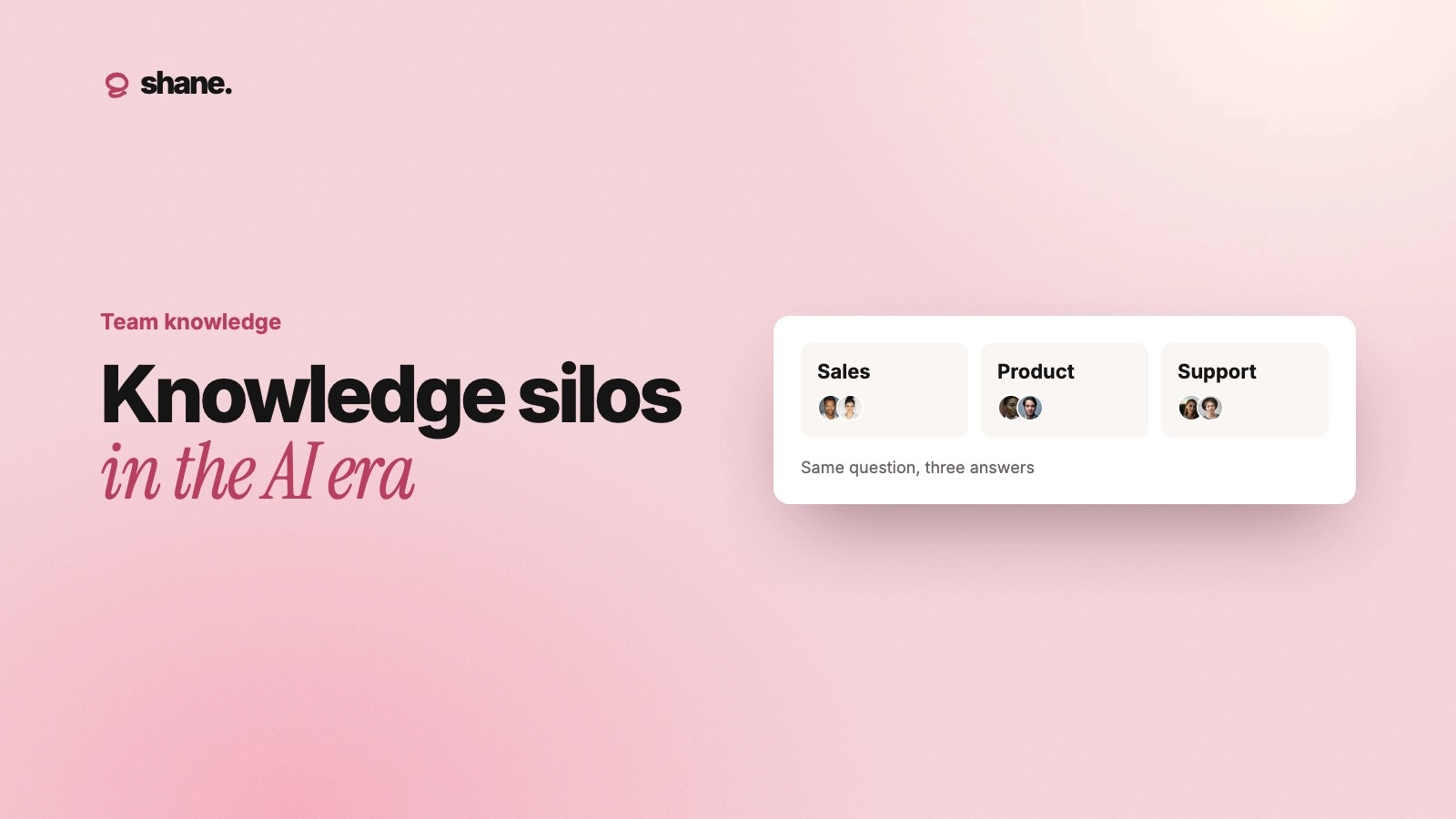
A knowledge silo is information that only one person, team or tool can reach, so everyone else works without it. In the AI era, silos have a new home: private AI chats, per-tool memory and personal prompts. You break them by finding where knowledge is stuck, deciding which of it the whole team needs, and putting that part in one shared place that people and AI tools both read.
Silos are an old problem. What's new is how fast AI tools create them, and how quietly. This post covers the silo types to look for, a one-hour audit, and the fixes that work.
Why silos are worse with AI
Silos were already expensive. A 2018 Panopto and YouGov survey of U.S. workers found that 42% of institutional knowledge is unique to the individual, and that workers lose 5.3 hours a week waiting for information or recreating it. Atlassian reports that 25% of the workweek is spent searching for information.
AI adds three things to that picture:
More people work in private. Gallup reports that 30% of U.S. employees use AI a few times a week or more, and 15% use it daily. A lot of real thinking now happens in a chat window nobody else sees.
More places for knowledge to sit. BetterCloud found that the average company runs 27 AI-powered SaaS apps. Each one can hold its own files, instructions and memory.
Personal accounts. Gartner found that 88% of employees with access to enterprise AI also use personal AI tools for work. Knowledge in a personal account is a silo the company can't even see. See shadow AI at work.
The result: a teammate can spend an hour getting an AI tool to understand your pricing rules, get a great answer, and leave every bit of that context in their own chat history.
The five types of knowledge silo
Most silos fit one of five types. Naming them makes them easier to spot.
Silo type | Example | Who loses out |
|---|---|---|
Person | Only Sam knows why enterprise contracts have a 60-day notice clause | Anyone covering for Sam |
Team | Support has a list of known bugs that product never sees | The team next door |
Tool | Release rules live in one Cursor rules file | People and agents using other tools |
AI chat | A great refund-policy explanation sits in one person's ChatGPT history | Everyone, including that person next month |
Format | The real decision is at minute 34 of a recorded call | Anyone who won't watch 60 minutes of video |
The AI chat silo is the newest and the easiest to miss. It feels like work is being shared because the output gets shared. But the context that produced the output, the corrections and the "no, we don't do that" moments, stays behind.
Not every silo is a problem
Some knowledge should stay with one person or team: salary data, legal matters, half-formed drafts. The goal isn't to put everything everywhere. It's to make sure knowledge the whole team needs isn't stuck in a place only one person can reach.
Run a one-hour silo audit
You can find your worst silos in an hour. Get three or four people from different teams in a room, or a shared doc, and work through these steps.
List the questions people ask most. "What's our current discount limit?" "Which customers are on the old plan?" "Why did we stop supporting the Android app?" Aim for 15 to 20.
For each question, write where the answer lives today. Be honest. "Priya's head" is a valid answer.
Mark the type. Person, team, tool, AI chat or format.
Mark the cost. What happens when someone gets it wrong? A wrong price in a proposal costs more than a wrong lunch order.
Pick the top three. Highest cost, most frequently asked.
Then ask one extra question for each of the three: if you pasted this question into the AI tool your team uses most, would it get the right answer? If not, that tool is working from a silo too.
How to break them
Move the answer, not the whole archive
Moving everything into one tool rarely fixes silos. It creates one big silo that is hard to search.
Instead, for each of your top three questions, write the current answer in two or three sentences, add the reason, and link to the source. That short, checked answer is worth more than the archive behind it. Our post on a single source of truth for an AI-first team covers how to decide where each kind of fact should live.
Give every area an owner
A silo often starts as an area nobody owns, so one person quietly becomes the only one who knows. Name an owner for each area: pricing, onboarding, release process, security answers. The owner doesn't have to know everything. They have to keep the shared answer current.
Make "ask in public" the default
When someone asks a question in a direct message, answer it in a team channel or the shared doc, then send the link. It stops the same question being answered privately five times.
Turn private prompts into shared skills
If one person has a prompt that produces great work, that prompt is a silo. Write it up with the context it needs and an example of good output, and put it where the team can use it. See turning one person's best prompt into a skill the whole team can use.
Point AI tools at shared sources
An AI tool only knows what it's given. If each person pastes their own version of the facts, each tool becomes a new silo. Put the shared answers somewhere every tool can read, and update them in one place.
Pull decisions out of meetings and chats
Knowledge in a recording or a long thread is technically shared but practically locked. After a meeting or a long AI session that ends in a decision, spend two minutes writing down what was decided and why, with a link back.
A worked example: the discount question
A 25-person company runs the audit. The most-asked question is "What discount can sales offer without approval?"
The answer lives with the head of sales, in an old Slack thread, and in two sales reps' personal AI chats, where each pasted a different version.
The cost is high: one rep quoted 25% when the limit is 15%.
The fix: the head of sales writes the rule in two sentences, adds the reason (margin on the annual plan), links the pricing decision, and puts it in the shared sales context that the team's AI tools read.
The next time a rep asks an AI tool to draft a proposal, it uses 15%.
Nothing about this needed a new platform. It needed one owner and ten minutes.
FAQ
What causes knowledge silos?
Usually a mix of no clear owner, tools that don't connect, and habits like answering questions in private messages. AI adds a new cause: people doing real thinking in private chats and personal accounts.
Are knowledge silos always bad?
No. Some information should be restricted, like HR or legal matters. A silo becomes a problem when knowledge the whole team needs can only be reached by one person or tool.
Can AI tools break silos?
They can help, for example by drafting summaries of meetings or long threads. But AI tools can only share what they can read. If each tool holds its own copy of the facts, AI makes silos worse.
How often should we audit for silos?
Once a quarter is enough for most teams, plus whenever someone senior changes roles. The handover problem is often where silos first show up.
Start with three questions
You don't need a big project to break knowledge silos. Find the three questions your team asks most and gets wrong most, write down the current answer with its reason and source, and make sure every person and AI tool reads that answer from the same place. Then do the next three.
We're building Shane to keep that shared answer in one place and hand it to every AI tool and teammate, with sources and permissions. If that's a problem your team has, you can join the waitlist at tryshane.ai.