A single source of truth for an AI-first team
What a single source of truth means when your team uses AI: what goes in it, the three rules that keep it current, and how to set one up in a week.
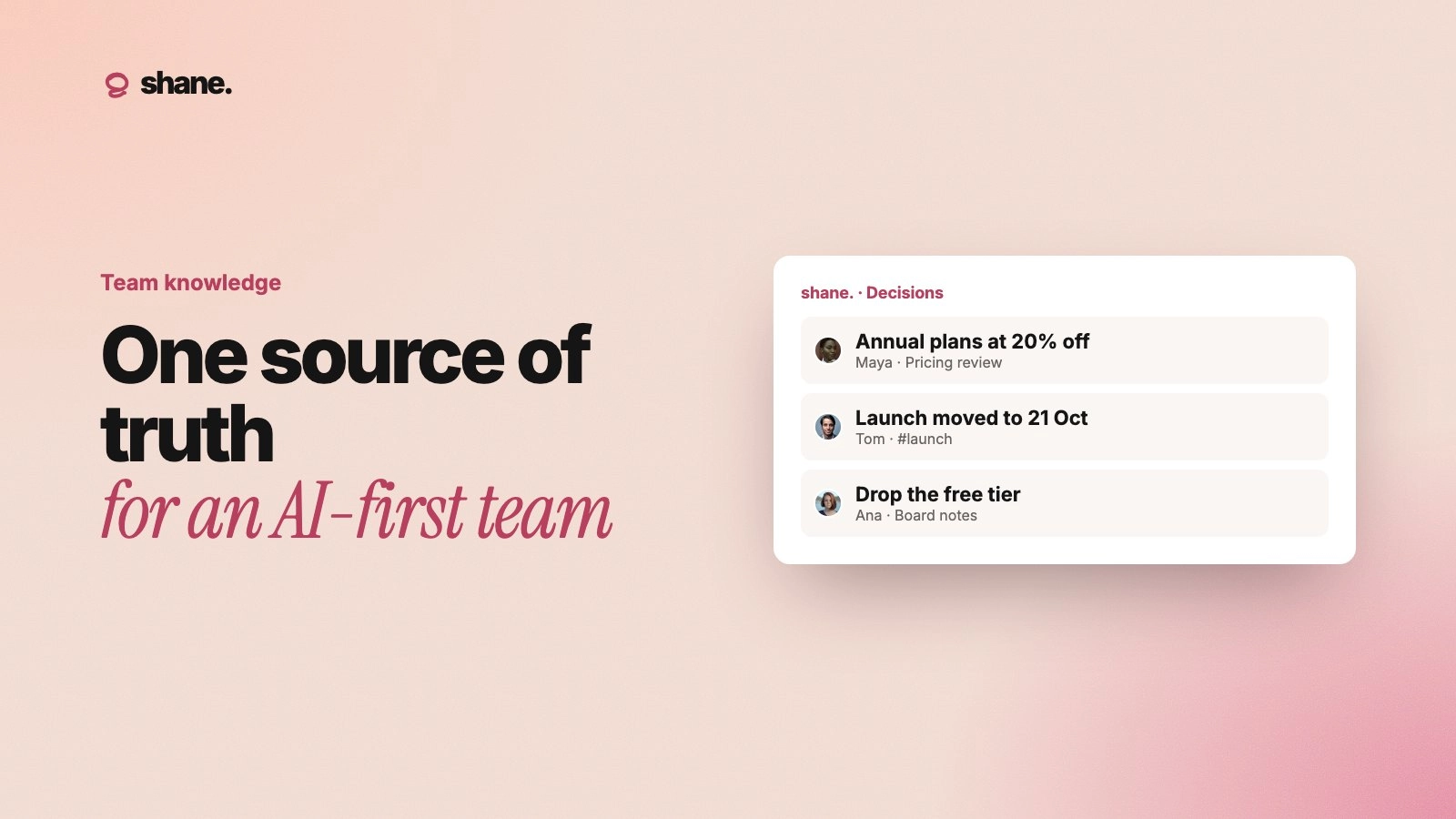
A single source of truth for an AI-first team is one agreed place where current decisions, rules and facts live, with an owner and a date on each, that both people and AI tools read from. It doesn't mean one tool for everything. It means that when two answers disagree, everyone knows which one wins.
AI makes this more urgent, not less. A person who finds two conflicting docs will usually ask someone. An AI tool will pick one and write a confident answer from it. This post covers what belongs in a source of truth, how to set one up, and how to keep it current.
Why AI raises the stakes
Most teams already have the raw material: docs, wikis, Slack threads, meeting notes and tickets. The problem is that the same fact often exists in several versions.
Atlassian found that 50% of knowledge workers have unknowingly worked on duplicate projects, and that a quarter of the workweek goes on searching for information. Now add AI. BetterCloud found the average company runs 27 AI-powered SaaS apps, and each one reads from whatever it's given or connected to.
So conflicting sources don't just slow people down. They get turned into polished, wrong output at scale:
A support assistant quotes the refund policy from an old help doc.
A sales draft uses the pricing page from before last month's change.
A coding agent follows an architecture note the team replaced in the spring.
What belongs in it
Not everything. A source of truth that tries to hold every document becomes another place nobody trusts. Start with the facts that change and that cause real damage when they're wrong.
Belongs | Doesn't need to |
|---|---|
Current pricing, discounts and plans | Every past version of the pricing page |
Policies: refunds, security, data handling | Long policy drafts still under discussion |
Product decisions and what's in or out of scope | Brainstorms and rejected ideas |
Names, launch dates and positioning | Full meeting transcripts |
Owners: who decides what | The whole org chart |
The test is simple. If an AI tool got this wrong in front of a customer, would it matter? If yes, it belongs.
The three rules that make it work
1. Every entry has an owner and a date
An entry without an owner is never updated. An entry without a date can't be trusted, because nobody knows whether it's current. Put both on every line: "Annual plans are 20% off. Owner: Maya. Updated 3 Oct."
2. One entry per fact
If the refund policy lives in the help center, the sales deck and a pinned Slack message, you have three sources. Pick one as the source. Everywhere else should link to it rather than copy it.
3. Newer replaces older, visibly
When a decision changes, update the entry and say what it replaced. "Free tier dropped on 28 Sep. Previously: free tier for teams under five." This stops old versions from coming back through someone's saved prompt or an AI tool's memory.
How to set one up in a week
You don't need a new tool to start.
List the twenty facts that matter most. Ask team leads which wrong answers cost the most last quarter.
Pick one home. A single page in the wiki or docs tool you already use is fine.
Write each fact as one line with owner, date and a link to where it was decided. If you keep a decision log, link each entry to it.
Point AI tools at it. Add it to your AI tools' project files or instructions, so drafts start from it instead of from whatever someone remembers. See how to give AI agents your company context.
Replace copies with links. Go through the help center, decks and pinned messages and link back to the source.
Set a review rhythm. Each owner checks their entries monthly, and immediately after any related decision.
Keeping it current
The hard part isn't building it. It's keeping it true. A few habits help:
Update at the moment of decision. The person who makes the call updates the entry the same day. Waiting for a weekly clean-up means a week of wrong answers.
Make staleness visible. Flag any entry not reviewed in 90 days.
Collect corrections. When someone spots an AI tool giving an outdated answer, trace it back and fix the source, not just the answer.
Keep it short. If the page grows past what someone can scan in five minutes, split it by team.
Common mistakes
Treating the wiki as the source of truth. A wiki with 400 pages is a library, not a source of truth. The source is the short list of current facts.
No owners. "The team owns it" means nobody does.
Copying instead of linking. Every copy is a future contradiction.
Forgetting the AI tools. If your AI tools don't read from it, they'll keep using old context. See why every AI chat starts from zero.
FAQ
Do we need a new tool for a single source of truth?
No. Start with one page in the tool you already use. What matters is that it's agreed, owned and dated. A tool only helps once those habits exist.
How is this different from a knowledge base?
A knowledge base explains how things work and can be large. A source of truth is the short list of current facts and decisions that everything else should agree with. Your knowledge base should link to it.
What if two teams disagree about which version is right?
That's the point of having owners. The owner of the entry decides, and the disagreement becomes a decision with a date. If nobody owns it, assign an owner first.
How do AI tools use it?
Add it to the files, instructions or connected sources your AI tools read from, so they start from current facts. Then check outputs against it when you review AI work. For a deeper look, see knowledge silos in the AI era.
Start with twenty facts
Pick the twenty facts that cause the most damage when they're wrong, give each an owner and a date, and point your AI tools at them. That small list will prevent more bad output than any amount of extra documentation.
We're building Shane to be the source of truth underneath every AI tool your team uses, with an owner, a date and a source on every decision. If that's a problem your team has, you can join the waitlist at tryshane.ai.